Notice, Application, and Appointment Milestones
Planning a civil marriage in Singapore becomes easier when each milestone has a clear owner. Choosing a date, preparing a ceremony, coordinating relatives, and booking a venue may happen at the same time, but they do not belong to one process.
A notice of marriage, marriage application, appointment, and solemnisation are related stages with different purposes. A date discussed with family is not necessarily available for solemnisation. A venue booking does not replace a civil process step. A religious or customary ceremony may follow a different sequence again.
This milestone map is a planning aid. Use the current public-service instructions for exact requirements, deadlines, fees, documents, and appointment arrangements. The available material does not establish those details reliably enough to present them as fixed rules.

More specific pages
These pages continue the topic in smaller, more specific directions.
The Singapore Civil Marriage Milestone Map
A useful planning sequence is:
- Choose the intended civil marriage route.
- Check the current public-service process.
- Prepare and submit the notice or application required for that route.
- Complete any verification or appointment arranged through the process.
- Confirm the solemnisation details with the relevant participants.
- Coordinate the civil ceremony with the venue, family events, and photography schedule.
- Keep separate records for civil, religious, venue, and family arrangements.
The order helps with planning, but it does not decide whether a couple qualifies, whether documents will be accepted, or whether an appointment or solemnisation date is available.
| Milestone | Main question | Likely next-action owner |
|---|---|---|
| Route decision | Which civil marriage process applies to the intended ceremony? | The couple |
| Notice or application | What must be submitted, and what confirmation follows? | The couple, subject to current public-service instructions |
| Verification or appointment | What information, documents, or participants must be confirmed? | The couple and the responsible registry process |
| Solemnisation | Who conducts the ceremony, and where will it take place? | The couple, solemniser, and venue |
| Wedding-day coordination | How does the civil ceremony fit with the rest of the day? | The couple, family, planner, venue, and vendors |
| Case-specific question | Does another authority or jurisdiction also need to be involved? | The couple, with the relevant authority or adviser |
When to File a Notice of Marriage in Singapore
The right time to begin notice of marriage planning depends on more than the preferred wedding date. The intended civil route, the couple’s circumstances, the information requested by the current process, and the availability of the solemnisation arrangement may all affect the sequence.
Work backwards from the date or date range you hope to use:
- Identify the intended civil solemnisation date or a realistic range.
- Read the current public-service instructions before treating the sequence as settled.
- Allow time to gather the information requested by the registry process.
- Confirm who will conduct the solemnisation and whether that person is available.
- Check whether the venue can support the ceremony at the required time.
- Leave room for questions involving a foreign spouse, another jurisdiction, or a separate religious process.
A family announcement, banquet booking, tea ceremony date, or religious celebration does not by itself establish that a civil filing deadline has been met. Those events may be planned around the civil milestone, but they do not define the civil procedure.
Because the supplied material does not verify exact notice periods or filing deadlines, check the current Registry of Marriages instructions before making non-refundable arrangements.
Notice, Application, Appointment, and Solemnisation: What Is the Difference?
These terms are often used together, yet each answers a different planning question.
Notice of marriage
A notice of marriage is part of the civil marriage process. For planning purposes, the important questions are whether it has been submitted through the current channel, whether further action is requested, and which confirmation should be retained.
“Notice” should not be treated as shorthand for final approval, a confirmed solemnisation slot, or acceptance of every document. The current public-service instructions control the specific meaning and sequence.
Marriage application
An application concerns the couple’s request to proceed with the marriage process. Depending on the current instructions and the couple’s circumstances, it may involve information, declarations, verification, or supporting material.
Keep a record of what was submitted, who submitted it, which confirmation was received, whether a further action was requested, and which date or appointment the confirmation relates to. The available material does not support a complete document list or a universal application workflow.
Appointment
An appointment is a scheduled point for verification, discussion, or another administrative action, depending on the current process. It should not automatically be understood as the solemnisation itself.
Before attending, confirm the date, time, location or platform, required participants, currently requested information or documents, and what confirmation should follow. An appointment can affect the confidence with which the couple plans the ceremony-day schedule, but its role must be checked rather than assumed.
Solemnisation
Solemnisation is the ceremony through which the civil marriage is conducted under the relevant civil process. It may be a small event or part of a larger wedding day. The surrounding celebration does not automatically form part of the civil procedure.
Confirm separately:
- Who will conduct the civil ceremony.
- Whether the solemniser has confirmed the date and arrangement.
- Where the ceremony will take place.
- Which venue rules apply.
- How witnesses, family members, photographers, and other guests will be positioned.
- What happens if the ceremony starts later than planned.
The Women’s Charter provides statutory context, but detailed case-specific interpretation should be checked against the current legislation and registry instructions.
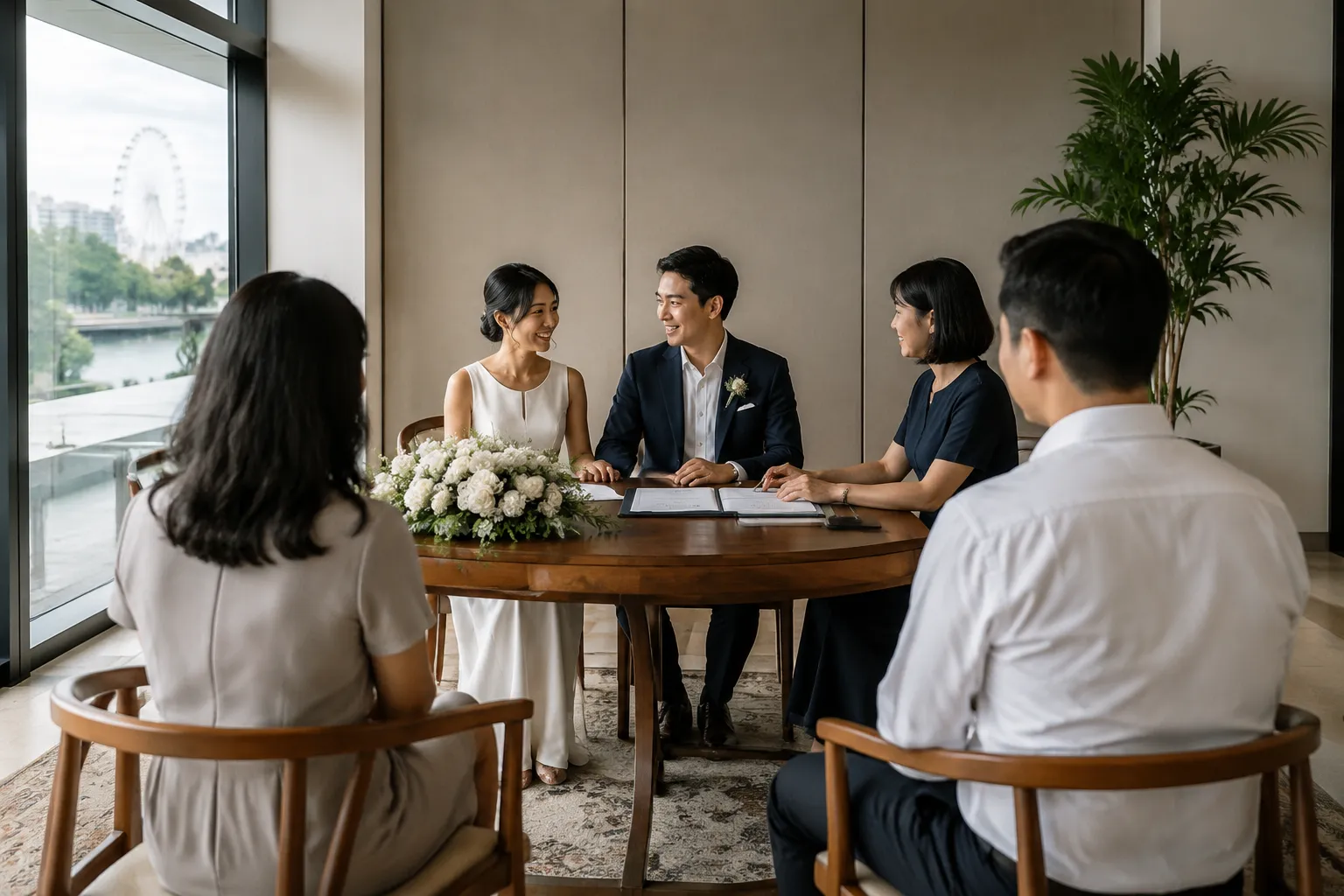
The Marriage Process Handoff: Who Acts Next?
A reliable planning file shows the next action, its owner, and the confirmation needed.
Before filing
The couple owns the planning decisions: the intended solemnisation date or date range, the civil ceremony location, the preferred ceremony size, and whether a religious or customary event will happen before or after the civil ceremony. The couple should also flag any possible cross-border or immigration question before asking relatives or vendors to treat the date as fixed.
After submission
The person who submits the notice or application should monitor the relevant confirmation. If one partner handles the administration, both partners should still know what was submitted, what remains outstanding, which dates are provisional, and where the records are stored.
This simple handoff prevents one person from assuming that the other has received or answered a follow-up request.
Before the appointment
Confirm the appointment details and prepare what the current public-service instructions request. A venue, planner, or family member may help with logistics, but they do not replace the couple’s responsibility to check the registry process.
Before solemnisation
The couple, solemniser, and venue should align on the practical arrangement. Confirm the ceremony start time, arrival times, room access, seating and witness arrangements, photography restrictions, sound and lighting, movement through the space, and a response to delays.
A venue may impose its own access or timing rules. Those are venue policies, not automatically civil requirements.
How Cultural and Religious Events Fit Around Civil Milestones
Singapore weddings may combine a civil solemnisation with Chinese tea ceremonies, gatecrash activities, Malay nikah or bersanding events, Indian temple or hall ceremonies, or other family and religious traditions. The order varies between couples and communities.
A customary or religious celebration can be meaningful without being interchangeable with the civil process. Research on marriage registration and ceremony practice in Singapore describes legal registration and later customary or religious events as distinct forms of activity. That context helps explain why families may use the word “wedding” for several different milestones, but it does not establish one sequence for everyone.
For planning, label each event clearly:
- Civil: notice, application, appointment, and solemnisation steps.
- Religious: requirements and ceremony order confirmed with the relevant religious contact.
- Family custom: practices agreed among the families.
- Venue: access, timing, food, photography, and space rules.
- Personal preference: choices about attire, guest participation, décor, and schedule.
A tea ceremony may be planned before the civil solemnisation because of family preference. A banquet may happen later because of venue availability. A religious ceremony may have its own preparation and participant requirements. These are possible arrangements, not universal rules.

Planning Around the Solemnisation Date
Once the civil milestone is clearer, build the rest of the day around it. A useful schedule identifies when the couple must be ready, when the solemniser and witnesses must arrive, when guests should enter, and when photography must finish for the next event.
Also account for travel between locations, meals, attire changes, and the person responsible for notifying the venue if the schedule changes. Gatecrash activities, outfit changes, transport, and photography can all affect the handoff into solemnisation, so avoid placing a tightly timed family event immediately beforehand unless someone is managing delays.
For an HDB home, discuss lift access, parking, available room space, neighbours, and the number of people moving through the unit. For a hotel or banquet venue, confirm the room access window, furniture layout, sound arrangements, and transition into the next programme. These are household or venue logistics, not registry requirements.
When the Usual Sequence Needs Extra Confirmation
Ask the relevant authority or provider directly when:
- One party is not a Singapore citizen or permanent resident.
- The couple has lived, married, or registered documents in another country.
- A foreign authority may need to recognise the marriage later.
- An immigration or work-pass matter is connected to the marriage.
- The couple is considering a religious route rather than a civil route.
- A family member assumes that a religious or customary ceremony changes civil status.
- The couple is unsure whether a document or personal circumstance affects the process.
- The preferred solemniser, venue, or date is not yet confirmed.
The appropriate contact may be the Registry of Marriages, another government authority, a foreign authority, a religious contact, the solemniser, the venue, or a qualified adviser. A general Singapore milestone map cannot determine recognition, document treatment, immigration consequences, eligibility, or appointment availability for an individual couple.
A Confirmation Sheet for Notice of Marriage Planning
Keep one shared file with five useful fields: the item, its current status, the owner, the confirmation source, and the next review point.
| Item | Current status | Owner | Confirmation source | Next review |
|---|---|---|---|---|
| Civil route | Open or decided | The couple | Current registry information | Before filing |
| Notice or application | Not started, submitted, or follow-up needed | Submitting partner | Registry confirmation | After submission |
| Appointment | Not requested, pending, or confirmed | The couple | Appointment confirmation | Before attendance |
| Solemniser | Shortlisted or confirmed | The couple and solemniser | Solemniser confirmation | Before invitations |
| Venue | Provisional or confirmed | The couple and venue | Venue policy or contract | Before the final schedule |
| Religious or customary event | Under discussion or confirmed | Family or religious contact | Relevant contact | Before programme printing |
| Cross-border question | Not applicable or referred | The couple | Relevant authority | Before relying on the answer |
The confirmation-source field prevents a family message, vendor assumption, or old checklist from being mistaken for current public-service information.
Common Mix-Ups to Resolve Early
“We booked the venue, so the date is settled.”
A venue booking and a civil solemnisation arrangement are separate confirmations. Keep the date provisional until the civil process and solemniser arrangement have been checked.
“The appointment is the same as the ceremony.”
An appointment may serve an administrative purpose. Confirm its role before building the wedding-day schedule around it.
“Our religious ceremony covers the civil step.”
Religious practice and civil registration may involve different authorities and requirements. Confirm the relevant route instead of treating one as a substitute for the other.
“One family’s sequence applies to every wedding.”
Chinese, Malay, Indian, interfaith, and blended weddings may use different combinations of events. Describe the chosen sequence as the couple’s arrangement, not as a rule for an entire community.
“A general checklist answers our personal case.”
A checklist can reveal missing questions, but it cannot decide eligibility, document treatment, recognition in another country, or appointment availability. Refer those questions to the relevant current source.
Frequently Asked Questions
When should we start notice of marriage planning?
Start when you have a likely civil solemnisation date and enough information to check the current process. Verify the live Registry of Marriages instructions before relying on a deadline or making arrangements that cannot easily change.
Does a notice of marriage confirm our solemnisation date?
Do not assume so. Notice, application, appointment, and solemnisation are separate milestones. Keep a separate confirmation for each stage.
Who is responsible for the next action?
Usually, the couple owns the civil planning and submission decisions. The registry process controls its administrative requirements, while the solemniser and venue control their respective confirmations. Write down the owner after every handoff.
Can a tea ceremony or banquet happen before the civil solemnisation?
It may, depending on family preference, religious practice, venue timing, and the civil arrangement. The sequence is not universal, so confirm each event independently.
Where can we check exact deadlines, fees, documents, or appointment rules?
Use the current Singapore public-service civil marriage information and Registry of Marriages instructions. The supplied research does not verify those details, so do not rely on an old checklist or general wedding guide for them.
What if one partner has a foreign connection?
Ask the Registry of Marriages and any relevant foreign or immigration authority about the specific issue. A general milestone map cannot determine recognition, document treatment, or immigration consequences.
The Practical Test
Before moving to the next wedding decision, you should be able to answer four questions:
- What milestone are we discussing?
- Who owns the next action?
- Which source has confirmed it?
- Which parts are civil procedure, and which are religious, venue, family, or personal choices?
That separation keeps notice of marriage planning manageable. It also makes uncertainty visible early, while a date, appointment, venue arrangement, or family programme may still be adjusted.

Sources
- Our Marriage Journey: Civil Marriage — Singapore public-service information for the civil marriage process. Check the current page for operational requirements.
- Our Marriage Journey: Plan Your Marriage — Singapore public-service planning information and process context.
- Women's Charter — statutory context for marriage and solemnisation in Singapore.
- 'We are registered': actual processes and the law of marriage in Singapore — limited historical and socio-legal context on registration and marriage practice.
- Religious Legal Pluralism Revisited – The Status of the Roman Catholic Church and Her Canon Law in Singapore — limited context for distinguishing religious structures from the civil legal process.