How to Invite and Confirm a Solemniser in Singapore
Start with a proposed date, time, venue and ceremony format. Find a solemniser through the current Our Marriage Journey civil marriage process, then contact the person directly with those details.

Do not treat one reply as the entire booking. You need three separate confirmation points: the solemniser accepts the event, the event details match, and the applicable Our Marriage Journey steps are complete. Public-service procedures may change, so check the live instructions before acting on dates or portal requirements.
- Set the proposed date, start time, venue and ceremony format.
- Use Our Marriage Journey to find a solemniser for a civil solemnisation.
- Ask about availability, language, ceremony manner and venue arrangements.
- Send the event details and request a clear acceptance.
- Record any conditions or information still required.
- Complete the applicable portal and marriage-application handoffs.
- Reconfirm the arrival window, access instructions and ceremony sequence.
Decide the details before making contact
A solemniser needs enough information to identify the event and assess availability. Before sending an invitation, assemble:
- Both partners’ names
- The proposed solemnisation date and start time
- The venue name and full location
- The specific room, unit or meeting point, when known
- Whether the ceremony is at ROM or another venue
- Whether it is standalone or part of a larger programme
- The preferred communication language
- A short description of the surrounding event sequence
- The name and contact details of the event coordinator
Use a specific time rather than “in the afternoon.” If the programme is still moving, identify the proposed time and say which details remain provisional.
Venue information should extend beyond a hotel, restaurant, hall or HDB block name. Parking, lifts, sheltered access, security registration and the route from the drop-off point may affect the solemniser’s arrival.

How to find a solemniser in Singapore
For couples searching for how to find a solemniser Singapore, the current Our Marriage Journey directory is the starting point for the civil route. A name appearing there does not establish availability for a particular wedding.
Shortlist people using practical questions rather than rankings:
- Are they available on the proposed date and at the required time?
- Can they communicate in the couple’s preferred language?
- Can they attend the proposed venue and ceremony format?
- What arrival window or meeting arrangement do they expect?
- What information do they need before accepting?
- Is there any outstanding issue that could affect the arrangement?
Ceremony manner is a personal preference, separate from the civil process. Some couples prefer a concise delivery; others want a warmer tone within a banquet programme. Ask what the solemniser is comfortable offering.
Wedding directories and testimonials may provide names to investigate, but they do not establish current status, suitability or availability. Check the public-service route and obtain a direct response from the solemniser.
What to include in the invitation
The first message should be brief but specific. Its immediate purpose is to establish whether the solemniser can consider the event.
Hello [name],
We are arranging our civil solemnisation and would like to ask whether you are available to solemnise our marriage.
Couple: [full names]
Date: [date]
Ceremony time: [time]
Venue: [venue name and full location]
Format: [standalone solemnisation / before a banquet / part of another programme]
Preferred communication language: [language]Our current event plan is [one or two sentences describing the ceremony and surrounding programme]. Please let us know whether you are available and what information or next steps you require.
Thank you,
[name and contact number]
This wording is a planning aid, not a prescribed form. Current public-service material supports contacting the solemniser and providing key event details, but it does not set one universal invitation format for every couple.
If a planner or family member makes the first approach, keep the couple visible in the conversation. Assign one person to manage follow-ups so that different schedules do not arrive from several contacts.

Get a clear acceptance of the event
A reply such as “I should be free” does not clearly settle the arrangement. Ask the solemniser to acknowledge the exact date, start time, venue and specific room or location.
The written confirmation should also cover:
- The agreed arrival or meeting window
- The communication language
- The broad ceremony format
- Information still required from the couple
- Any remaining portal or administrative action
Keep the acceptance in an email or message thread. If the details were discussed by telephone, send a short recap and ask the solemniser to acknowledge it.
Thank you for speaking with us. We understand that you are available for our solemnisation on [date] at [time] at [full venue]. The ceremony will take place before our banquet, and our coordinator will meet you at [meeting point]. Please confirm that these details are correct and advise whether anything remains to be completed.
Complete the Our Marriage Journey handoffs
The civil marriage process separates related tasks, including preparing the marriage application, arranging the solemniser and completing declarations. Follow the sequence displayed in the live Our Marriage Journey process for your circumstances.
Use three status labels in the wedding plan:
- Solemniser contacted: The invitation has been sent, but there is no acceptance yet.
- Solemniser confirmed: The person has accepted the stated date, time and venue.
- Administrative handoff completed: The relevant portal step has been completed or acknowledged as required.
This distinction prevents two common misunderstandings. A friendly acceptance may still leave a portal action outstanding, while finding someone through the portal does not necessarily mean that person has accepted the event details.
The supplied civil process overview describes the solemnisation date as being at least 21 days after the marriage application. It also describes a reminder at least three days before certain solemnisation arrangements outside ROM or conducted through video link. Treat both as changing process information and verify the current wording, timing and conditions before fixing dependent bookings.
Brief the solemniser and venue
Once the arrangement is in place, send a compact event brief. Include only the surrounding details that affect arrival, setup and the ceremony start:
- Venue access and meeting point
- The coordinator’s name and mobile number
- The planned arrival window
- The handoff from the preceding event
- The positions of the couple and two witnesses
- Microphone arrangements, when applicable
- Movement between rooms or an attire change
- A wet-weather alternative for an outdoor setting
For example, a couple may hold a tea ceremony in a hotel suite, solemnisation in a function room and lunch in the ballroom. The solemniser needs the lift route, meeting point and start cue, not the entire family programme.
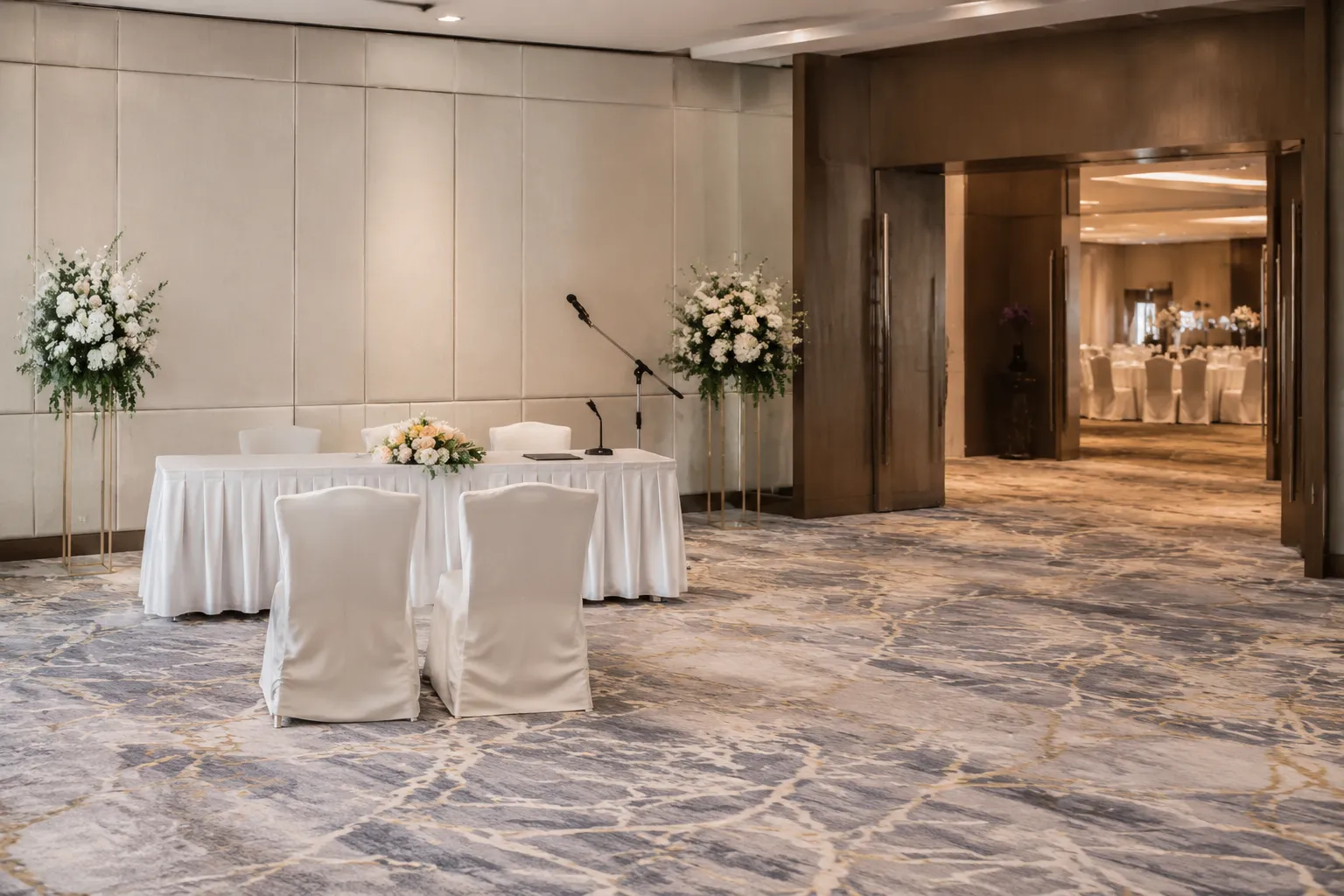
Venue permission remains a separate confirmation point. Ask the venue contact about room access, registration, parking, sheltered routes, equipment and any event occupying the space beforehand.
Customary and religious programmes also remain distinct from civil requirements. A tea ceremony, gatecrash, religious rite or family blessing may sit around the solemnisation, but its sequence depends on the relevant family or religious context.
Reconfirm what could affect attendance
Send a final operational message at the point requested by the solemniser or shown in the current process. Keep it limited to details that may affect attendance:
- Date, start time and arrival window
- Full venue, room and meeting point
- The coordinator’s contact number
- Parking, lift, access or security instructions
- Material changes to the ceremony format
- The contingency location, where relevant
Do not silently move the ceremony because a banquet, photography session or family programme has changed. Ask whether the revised time works and obtain a fresh acknowledgment.
If nothing has changed, a short message is enough. Sending several versions of the schedule can make the final arrangement less clear.
Keep civil, venue and religious roles separate
Current public-service guidance describes solemnisation as including identity checks for the couple and two witnesses, together with verbal consent from both parties. Consult the live guidance for the full process applying to your case.
The solemniser is not automatically the banquet host, wedding planner, religious contact, family representative or venue coordinator. Ask before assigning speaking or programme duties beyond the expected civil ceremony role.
This article addresses the civil marriage context. The Registry of Marriages and Registry of Muslim Marriages operate distinct administrative pathways, with different roles and terminology.
A wedding style, venue or family custom does not determine the applicable route. Couples who are unsure should seek case-specific direction from ROM or ROMM. Venue questions belong with the venue, while religious practice belongs with the relevant religious contact.
Final confirmation checklist
- The solemniser has accepted the exact date, time and venue.
- The room and meeting point match across all messages.
- The applicable Our Marriage Journey steps have been checked.
- The couple knows which actions remain outstanding.
- The solemniser has the current event brief.
- One coordinator owns the arrival and venue handoff.
- The two witnesses are included in the ceremony plan.
- Access and wet-weather arrangements are settled where relevant.
- Any revised start time has been accepted directly.
- Religious, customary, venue and overseas-recognition questions have been routed separately.
The arrangement is ready when the person, event details and administrative handoff agree. Keep those as three connected checks, not one assumed booking.