Documents and Identity Checks
Planning a Singapore civil solemnisation involves more than asking, “What documents should we bring?” The more useful question is which information, document, confirmation, or identity check matters at each stage, and who can confirm it for this couple.
A generic checklist may not cover every situation. The answer can change with the process route, each party’s circumstances, whether one party is a foreign spouse, and whether the civil solemnisation sits alongside a religious or customary celebration.
This page follows the planning sequence from application to solemnisation day. It keeps civil process information separate from venue instructions, solemniser arrangements, religious practice, and family custom. Use it as planning information rather than as an eligibility decision or a determination that a particular document will be accepted.
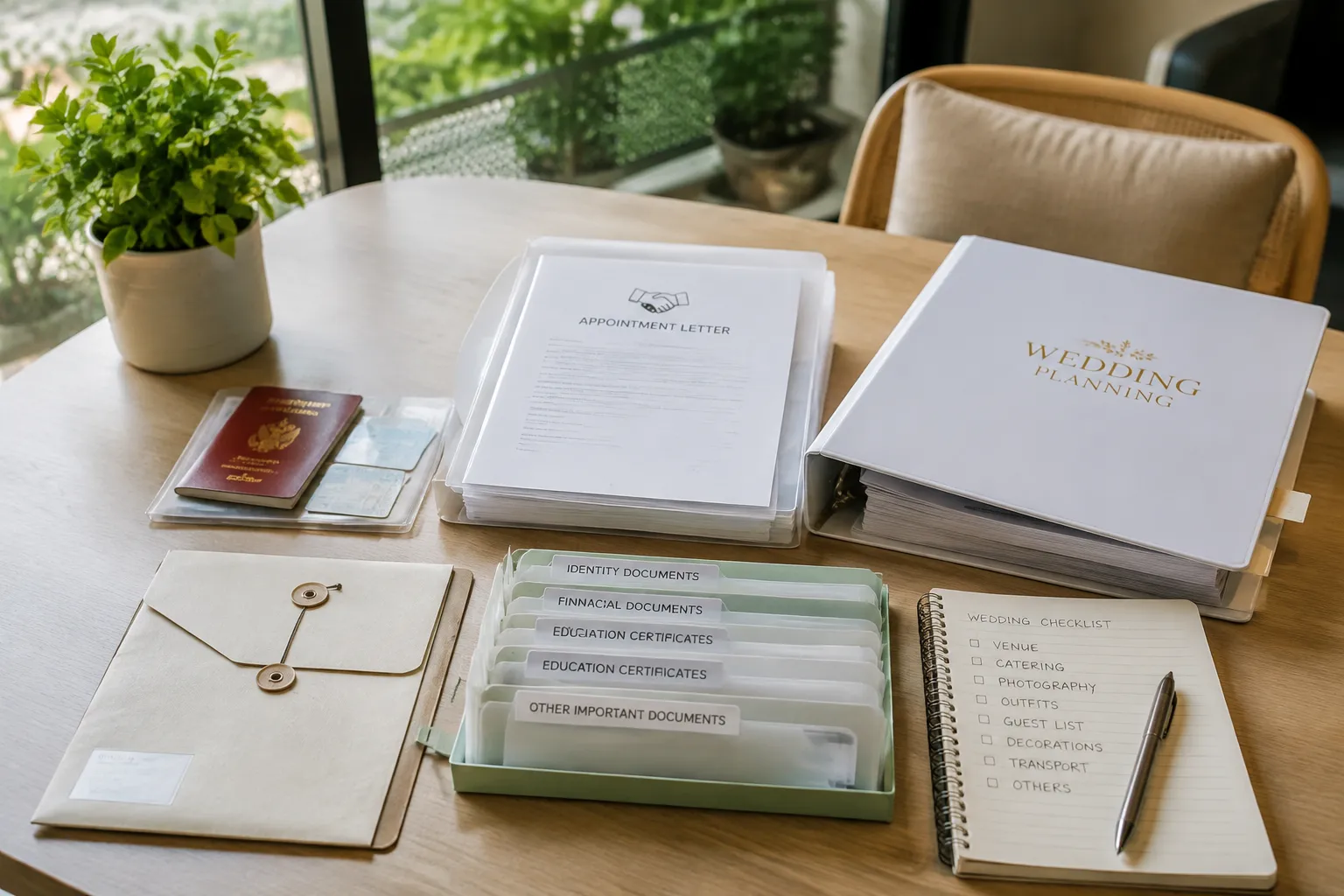
More specific pages
These pages continue the topic in smaller, more specific directions.
What counts as a solemnisation document?
In everyday wedding planning, “solemnisation documents” can refer to several different things:
- Information or documents submitted during the marriage application
- Identity evidence used during a verification step
- Documents requested because of a previous marriage or another personal circumstance
- Appointment or solemnisation confirmations
- Identification documents or records that may need to be available on the day
- Additional documents connected with a foreign spouse or immigration status
These categories should not be combined into one permanent checklist. A document submitted during an application is not necessarily something that must be presented at the venue. Similarly, a venue booking confirmation or solemniser instruction is not automatically part of the civil registration process.
Identity evidence is assessed in context by the relevant authority or service provider. Having a document does not, by itself, establish that it meets the needs of a particular service. For questions about a Singapore marriage process, start with the current marriage-process instructions and direct case-specific questions to the relevant public-service contact.
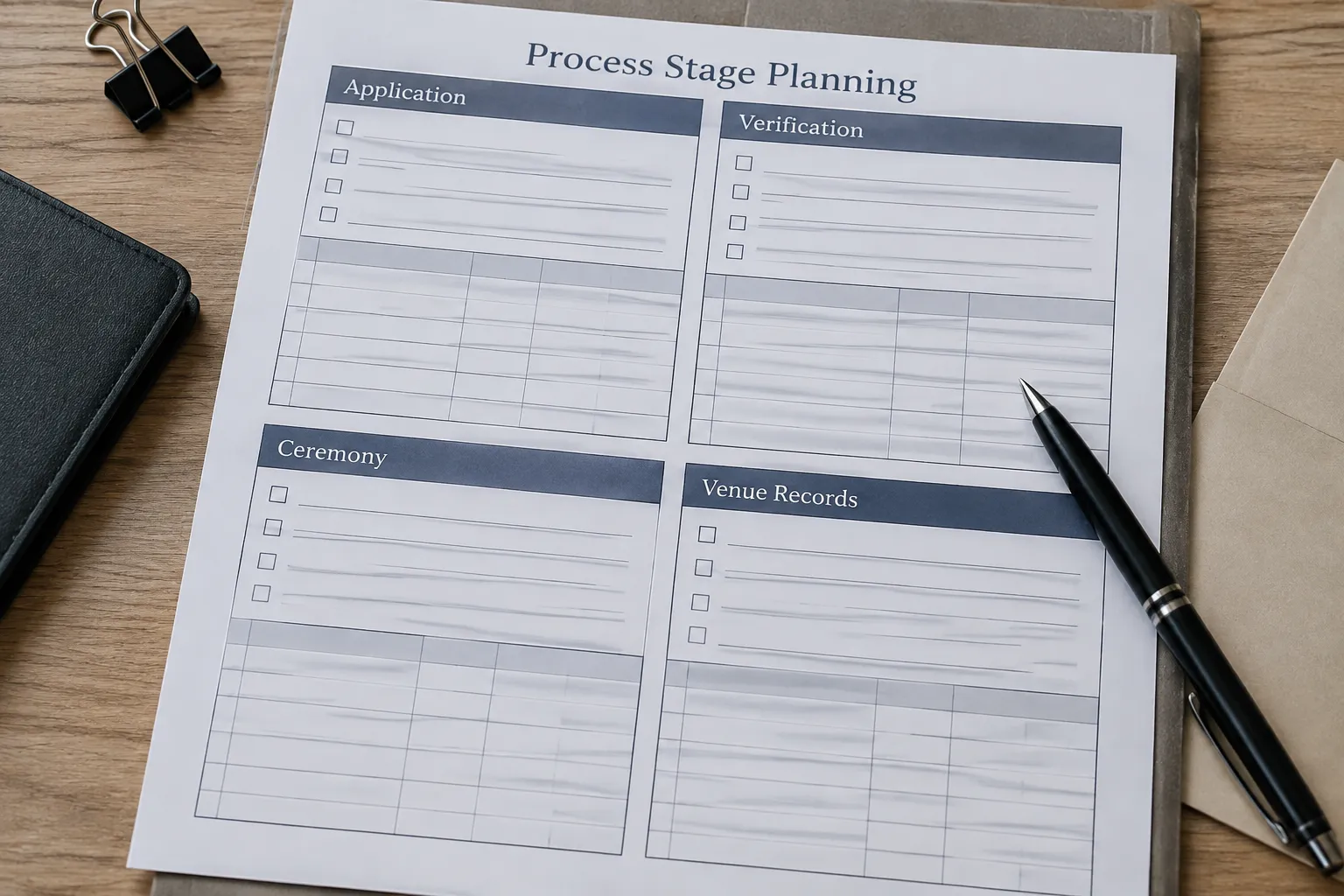
Singapore solemnisation documents by process stage
A staged record is easier to maintain than one long list. Four useful labels are submit, verify, bring, and venue-only.
| Stage | What to prepare | What to verify | Who can confirm |
|---|---|---|---|
| Application | Information and documents requested for the application | Names, personal details, and case-specific fields | Current marriage-process guidance or the relevant Registry contact |
| Notice or pre-appointment checks | Any additional information requested before the appointment | Dates, notices, declarations, and identity instructions | The relevant public-service contact |
| Declaration or appointment stage | Identification and confirmations for the scheduled step | Who must attend and what must be presented | The relevant Registry contact or solemniser, where applicable |
| Solemnisation day | Identification, appointment details, and venue records that may apply | Arrival time, location, solemniser instructions, and document handling | The solemniser, venue, or relevant public service |
This is a planning framework, not a universal document list. The available material supports the broad process sequence but does not provide enough verified detail to name every current document, deadline, declaration, or day-of requirement. Check the live source before relying on a saved checklist.
1. Application stage
Begin with the personal information requested by the current Singapore marriage-process guidance. Compare the records you plan to use before submitting anything, especially where names or identity details appear in more than one format.
- The spelling and order of each name
- Identification or passport details
- Dates of birth and nationality information
- Contact details used for the application
- Information relating to a previous marriage or change of personal status
- The intended solemnisation date and location, if already arranged
A document used for another administrative purpose should not be assumed to meet the needs of a marriage application. The current public-service wording should determine what is requested.
Raise unusual document histories, previous-marriage records, foreign-issued documents, replacement documents, or mismatched details before treating the application as complete. Early clarification gives the couple more room to resolve a discrepancy before a scheduled step.
2. Notice and pre-appointment checks
This stage is where civil-process requirements and wedding logistics are most easily mixed together.
A venue may ask for a booking record, vendor details, access information, or a final guest count. A solemniser may provide instructions about timing, attendance, or the ceremony arrangement. Those instructions can matter to the day without replacing the civil-process instructions.
Check:
- Whether the planned date still matches the submitted information
- Whether both parties must attend a particular step
- Whether a declaration or confirmation is required before solemnisation
- Whether additional identity evidence has been requested
- Whether the solemniser has received the information needed for the ceremony
- Whether the venue has a separate document or access procedure
Do not treat an older article, discussion thread, or copied checklist as a current deadline or notice requirement. Use it only to identify a question that needs checking against the current public-service source.
3. Declaration and appointment confirmation
The declaration or appointment stage deserves a separate check. Couples may regard it as a formality and overlook who needs to attend, which records need to match, or what identity evidence may be required.
Keep these records together:
- The appointment or solemnisation confirmation
- Instructions received from the relevant public service
- Instructions received from the solemniser
- Identity-document guidance that applies to both parties
- Notes on unresolved questions and the person or service responsible for answering them
Ask for clarification if the names on a confirmation do not match the identity documents, a document has expired or been replaced, or one party’s records use a different spelling or format.
The right confirmation point depends on the question. A public-service contact handles civil-process questions. The solemniser can clarify ceremony-specific instructions within their role. The venue can explain access, timing, registration, and event-day requirements. A religious contact should address religious ceremony or community practice.
What to bring to a Singapore solemnisation
“What to bring” can describe three different needs:
- Documents submitted earlier in the process
- Identification or confirmations needed for a scheduled civil step
- Practical records and items needed to run the ceremony at the venue
Keep these categories separate in the planning file or phone notes.
Civil-process records
Keep the current appointment or process confirmation accessible, together with written instructions stating what the couple must present or complete. Do not add documents simply because they appear on a generic wedding checklist.
Identity documents
Check the current identity instructions for both parties before the day. The relevant document may depend on citizenship, residency, nationality, or another case-specific factor. Follow the wording of the current instruction rather than substituting a document based on assumption.
Where a foreign-issued document, replacement document, or name difference is involved, confirm the position in advance. A photograph or scan can help organise records, but should not be assumed to replace the form of identification requested for the appointment.
Venue and ceremony records
Venue and ceremony records may include:
- Venue booking details
- Access or registration instructions
- Solemniser contact information
- Ceremony timing
- Room or venue directions
- Instructions for photography, family entrance, or cultural elements
These records help coordinate the day, but they belong to the event plan rather than the civil document list.
Foreign-spouse identity documents and immigration questions
A foreign spouse may create a separate confirmation path. Marriage-process guidance may not answer every question about immigration status, entry records, or additional identity documents.
Use immigration guidance for questions involving:
- A foreign spouse
- Immigration status
- Additional identity or travel documents
- A document issued outside Singapore
- Coordinating marriage planning with a separate immigration process
This is a referral path for case-specific questions, not a reason to assume that every couple with one foreign spouse follows the same process. The available material does not support a universal list of foreign-spouse documents, processing times, or individual outcomes.
When contacting the relevant authority, describe the situation precisely. Useful details may include each party’s nationality, the document type, whether it is current, and whether the question concerns the application, declaration, or solemnisation day. Ask which requirement applies to the specific stage rather than asking only for a general wedding checklist.

Civil documents, religious ceremonies, and family customs
A Singapore wedding may include several layers:
- Civil solemnisation
- A Chinese tea ceremony
- A gatecrash
- A Malay nikah or bersanding event
- An Indian temple or hall ceremony
- A banquet or family reception
- Interfaith or blended-family elements
These layers may happen on the same day without sharing the same document requirements.
A family may need to coordinate tea ceremony gifts, a religious contact may provide ceremony instructions, and a hotel may require event-day registration. None of those arrangements should be presented as a universal civil requirement.
Civil marriage administration and religious marriage administration should also remain distinct. If the couple’s ceremony involves a religious registration route, confirm the current requirements with the relevant religious or public-service contact. This page does not determine which route applies to an individual couple or provide a religious ruling.
Common misunderstandings about solemnisation documents
“One checklist should cover everything.”
A single list may omit an application-stage requirement, include irrelevant day-of items, or fail to address a foreign-spouse question. Mark each item as submit, verify, bring, or venue-only.
“A venue requirement is a civil requirement.”
Venues can set their own rules for access, identification, vendors, photography, guest movement, and timing. Attribute those instructions to the venue and keep them separate from marriage-process information.
“A scan is the same as the original.”
A scan can help organise records, but it should not be assumed to meet a presentation requirement. Confirm the accepted form with the relevant authority or solemniser.
“The solemniser can answer every document question.”
A solemniser may clarify instructions connected with the ceremony. Questions about civil processing, immigration status, or document acceptance may need to go to the relevant public service.
“A previous article’s deadline is still current.”
Process instructions can change. Check the live public-service page before relying on a deadline, sequence, declaration instruction, or list of documents, and record the date of that review in the planning notes.
A practical confirmation sequence
- Identify the intended civil process route and solemnisation date.
- Read the current Singapore marriage-process guidance.
- Separate information to submit from documents to present later.
- Compare both parties’ names and identity details across their records.
- Flag previous-marriage, foreign-issued, replacement, or inconsistent documents.
- Ask the relevant public-service contact about unresolved civil-process questions.
- Use immigration guidance when a foreign spouse or immigration-status issue is involved.
- Ask the solemniser about ceremony-specific instructions.
- Ask the venue about access, timing, registration, and event-day records.
- Recheck the instructions close to the appointment because the current wording matters more than a saved checklist.
Questions to ask before the solemnisation day
- Which documents are required at the application stage?
- Which documents, if any, must be presented at the declaration or appointment?
- Does each party need to attend a particular step?
- Are there additional identity checks for this specific situation?
- Does a foreign-issued or replacement document require separate confirmation?
- Is the question about civil processing, immigration status, ceremony instructions, or venue policy?
- What should be brought to the venue on the day?
- If a document or name detail changes before the appointment, who should be informed?
Frequently asked questions
What documents are submitted during the Singapore marriage process?
The exact set depends on the current process instructions and the couple’s circumstances. Use the current marriage-process page as the procedural starting point rather than relying on a universal document list.
What identity checks may apply to a solemnisation?
Identity checks may apply at different stages, including application, declaration, appointment, or solemnisation day. The relevant authority determines what evidence is acceptable in context. Confirm the current instruction for both parties.
Are solemnisation-day items the same as application documents?
Not necessarily. Application documents, identity evidence, appointment confirmations, and venue records serve different purposes. Keep them in separate sections of the planning file.
Where should a foreign spouse ask about additional documents?
Start with the current marriage-process guidance, then use the relevant immigration marriage guidance for immigration-status or additional identity-document questions. A specific situation may require direct confirmation.
Do Chinese, Malay, Indian, or interfaith ceremonies require the same documents?
Not always. Civil process requirements, religious or customary ceremony instructions, family preferences, and venue policies may sit alongside one another without being interchangeable. Confirm each layer with the relevant contact.
Can a venue or solemniser confirm whether a document will be accepted?
They may clarify instructions within their role, but document acceptance for a civil or immigration process should be confirmed with the relevant authority. A venue example or ceremony instruction should not be treated as a general rule.
The working rule
Prepare by stage, label each item by purpose, and assign every unresolved question to the right contact. A useful solemnisation document plan is not the longest checklist. It distinguishes what is submitted, what is verified, what may need to be presented, and what belongs only to the ceremony or venue.
Use the current marriage-process guidance for changing civil-process information. Use immigration guidance for foreign-spouse or status questions. Let the solemniser, religious contact, and venue confirm the instructions that fall within their own part of the wedding plan.
Sources
- Our Marriage Journey (Singapore public-service information; reviewed for current process context)
- Marriage Process (Singapore public-service process guidance; reviewed for current process context)
- Immigration and Checkpoints Authority: Marriage-Related Matters (immigration referral for foreign-spouse and status questions; reviewed for current context)
- Towards standardizing trusted evidence of identity (academic source used for general identity-evidence terminology and context)